



Executive Summary
The contemporary landscape of global spirituality is often dominated by charismatic figures and vocal leadership. In stark contrast stands His Holiness Mahant Swami Maharaj, the sixth spiritual successor of Bhagwan Swaminarayan and the present Guru of the Bochasanwasi Akshar Purushottam Swaminarayan Sanstha (BAPS). Leading a global socio-spiritual organization comprising over 1,200 mandirs (temples), 5,025 centers, and a dedicated legion of over 80,000 volunteers, Mahant Swami Maharaj commands a reverence that stems not from oratory dominance but from a radical practice of humility, silence and servitude.
This comprehensive research report provides an exhaustive analysis of Mahant Swami Maharaj’s life, theological significance and administrative leadership. It traces his trajectory from a rationalist agricultural student in Anand, Gujarat, to the helm of a transnational Hindu movement. The report examines the historical lineage of the BAPS Guru tradition, the intricacies of his transition from “Vinu Bhagat” to “Mahant Swami” and his pivotal role in constructing modern architectural marvels such as the BAPS Swaminarayan Akshardham in Robbinsville, New Jersey and the BAPS Hindu Mandir in Abu Dhabi. Furthermore, this document provides an in-depth operational and thematic overview of the upcoming 92nd Janma Jayanti Mahotsav scheduled for February 2026 in Atladra, Gujarat. Through detailed biographical research, theological analysis and firsthand accounts of devotee experiences, this report elucidates how a leader defined by “Dasbhav” (servitude) drives one of the most dynamic religious movements of the 21st century.
1. Introduction: The BAPS Swaminarayan Sanstha and Its Spiritual Head
1.1 The Organization: A Global Socio-Spiritual Force
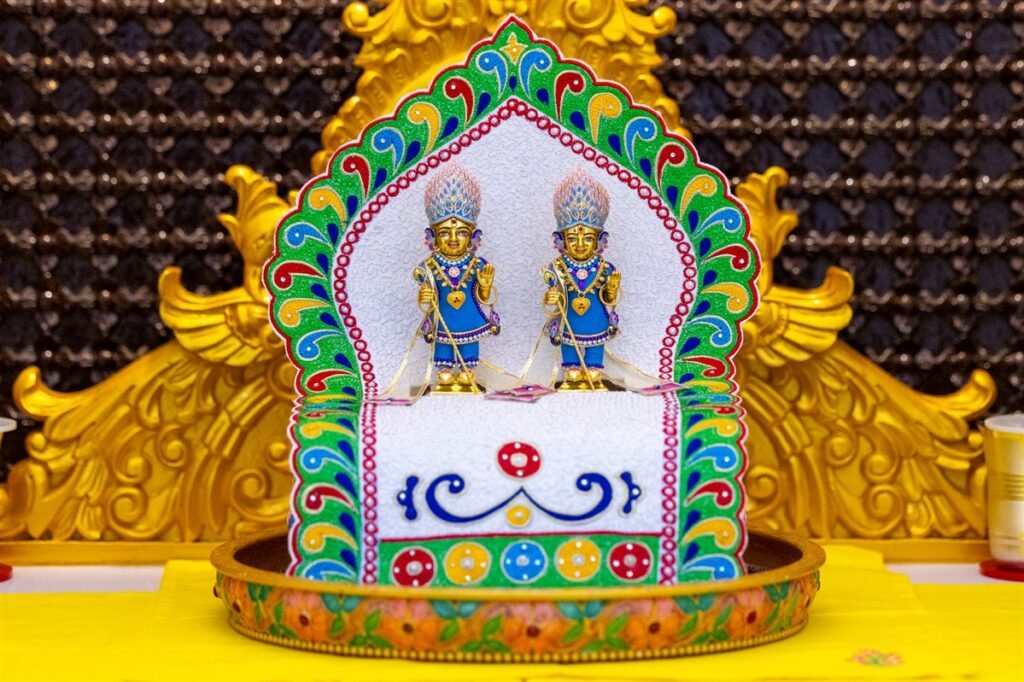
The Bochasanwasi Akshar Purushottam Swaminarayan Sanstha (BAPS) represents a unique branch of the Swaminarayan Sampradaya, distinguished by its specific theological interpretation of the Akshar-Purushottam Darshan. Established formally in 1907 by Shastriji Maharaj, BAPS posits that Bhagwan Swaminarayan (1781–1830) remains ever-present on earth through a lineage of Gunatit Gurus. This belief system transforms the organization from a mere administrative entity into a spiritual organism where the Guru is the central pivot of faith.
From its roots in rural Gujarat, BAPS has evolved into a massive global entity. Its activities span beyond religious worship to include disaster relief, educational support, environmental conservation and medical services. The organization holds Consultative Status with the Economic and Social Council of the United Nations, reflecting its impact on global civil society. The leadership of this vast network requires a unique blend of spiritual depth and administrative acumen—qualities that the current Guru, Mahant Swami Maharaj, embodies through a philosophy of “leading from behind”.
1.2 The Profile of Leadership: Mahant Swami Maharaj
At the apex of this organization stands Mahant Swami Maharaj (born Vinubhai Patel). His leadership style is often described as paradoxical in the modern world: he wields immense authority yet claims to be the servant of the servant (“Das no Das”). Since assuming the role of Guru in 2016 following the passing of His Holiness Pramukh Swami Maharaj, Mahant Swami Maharaj has overseen a period of unprecedented expansion. This includes the inauguration of the largest Hindu temple in the Western Hemisphere and the first traditional stone temple in the Middle East. His tenure has been marked by a focus on “Samp” (Unity), “Suhradbhav” (Fraternity), and “Ekta” (Oneness), doctrinal pillars he emphasizes as essential for spiritual and social progress.
2. The Theological Foundation: The Guru Lineage
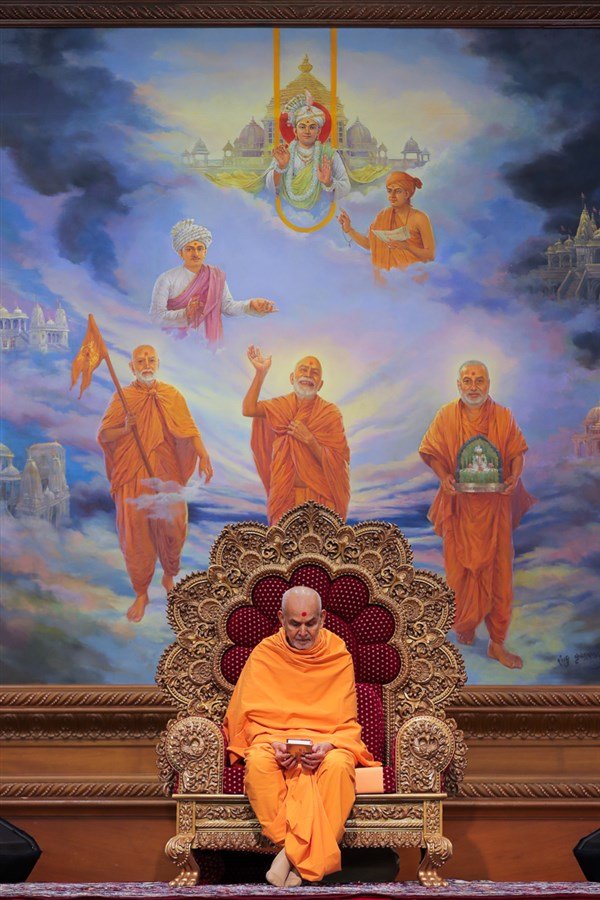
To understand the magnitude of Mahant Swami Maharaj’s position, one must comprehend the Guru Parampara (lineage) that serves as the spiritual backbone of BAPS. The central tenet of the sect is that the path to Moksha (liberation) requires the guidance of the Pragat Satpurush (Manifest Guru), who is the form of Aksharbrahma on earth.
2.1 The Philosophy of Akshar-Purushottam
The BAPS theology is grounded in the Akshar-Purushottam Darshan, revealed by Bhagwan Swaminarayan in the Vachanamrut. It distinguishes between two eternal entities:
- Purushottam: The Supreme God (Bhagwan Swaminarayan).
- Akshar: The eternal abode and ideal devotee of God.
Devotees believe that to know Purushottam, one must identify with Akshar. Mahant Swami Maharaj is revered as the current manifestation of Akshar. Therefore, for a BAPS devotee, the Guru is not merely a teacher but the “Moksha-data” (grantor of liberation) and the bridge to the divine.
2.2 The Spiritual Succession
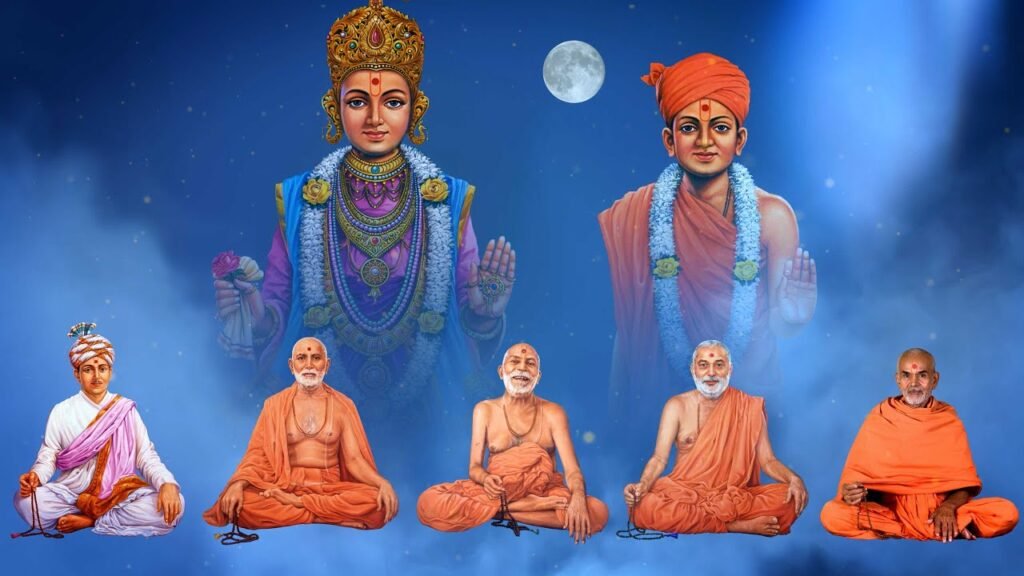
The lineage is viewed as a single spiritual entity continuing through different physical bodies. The succession is uninterrupted:
| Sequence | Name | Tenure & Significance |
| 1st | Gunatitanand Swami (1785–1867) | The original manifestation of Akshar; established the foundation of the philosophy during Bhagwan Swaminarayan’s time. |
| 2nd | Bhagatji Maharaj (1829–1897) | A tailor by caste who broke social barriers and propagated the understanding of Gunatitanand Swami as Akshar. |
| 3rd | Shastriji Maharaj (1865–1951) | The founder of BAPS (1907); built the first five temples dedicated to Akshar-Purushottam in Bochasan, Sarangpur, Gondal, Atladra and Gadhada. |
| 4th | Yogiji Maharaj (1892–1971) | Known for his infectious joy and focus on youth; the Guru who initiated Mahant Swami Maharaj. |
| 5th | Pramukh Swami Maharaj (1921–2016) | The master builder and global traveler who expanded BAPS internationally; Mahant Swami Maharaj’s immediate predecessor. |
| 6th | Mahant Swami Maharaj (1933–Present) | The current Guru; revered as the “Pragat” (Manifest) form of Akshar today. |
Mahant Swami Maharaj is believed to be in constant communion with Bhagwan Swaminarayan. His decisions are seen as divine will (“Agna”) and his life is viewed as a continuous stream of “Lila” (divine actions) meant to guide devotees toward spiritual perfection.3
3. Early Life: The Making of a Visionary (1933–1951)
3.1 Birth and Family Heritage
Mahant Swami Maharaj was born as Vinubhai Patel on September 13, 1933 (Bhadarva Vad 9, Samvat 1989), in Jabalpur, Madhya Pradesh, India. His parents, Manibhai Narayanbhai Patel and Dahiben, were devout followers of Shastriji Maharaj. Manibhai was originally a native of Anand, Gujarat, but had moved to Jabalpur for business purposes, specifically running a dairy business, following the blessings of Shastriji Maharaj.
A few days after his birth, Shastriji Maharaj visited the family home in Jabalpur. In a moment of prescience, the founder of BAPS blessed the newborn and named him Keshav. He prophesied to Manibhai, “Your child will grow up to become a sadhu and will render great service to the Sampradaya in a big way.” Despite this formal naming, the family affectionately called him “Vinu,” a nickname that stayed with him through his youth and college years.
3.2 Education and Intellectual Inclinations
Vinubhai’s upbringing was characterized by a synthesis of deep domestic spirituality and rigorous modern education. He spent his formative years in Jabalpur, a city that offered a cosmopolitan environment in pre-independence India.
- Primary & Secondary Education: He attended an English-medium school, completing his 12th grade at the prestigious Christ Church Boys’ Senior Secondary School in Jabalpur. This English-language education was relatively rare for the time and equipped him with a global perspective and linguistic capabilities that would later prove vital in communicating with the Western diaspora.
- Higher Education: Following his secondary education, the family returned to their native Anand. Vinubhai attended Vitthalbhai Patel (V.P.) Science College initially and then enrolled at the Bansilal Amrutlal College of Agriculture (affiliated with Anand Agricultural University) in 1953. He graduated with a Bachelor’s degree in Agriculture in 1956.
During his student years, Vinubhai was known for his sharp intellect. He was not inherently devotional in an emotional sense; rather, his mind was inclined towards rational and logical reasoning. He possessed a “deep inner spirituality,” but it was guarded by a wall of intellect. He required a teacher who could appeal to his reason while awakening his heart.
4. The Spiritual Awakening: Meeting Yogiji Maharaj (1951–1957)
4.1 The Catalyst of Transformation
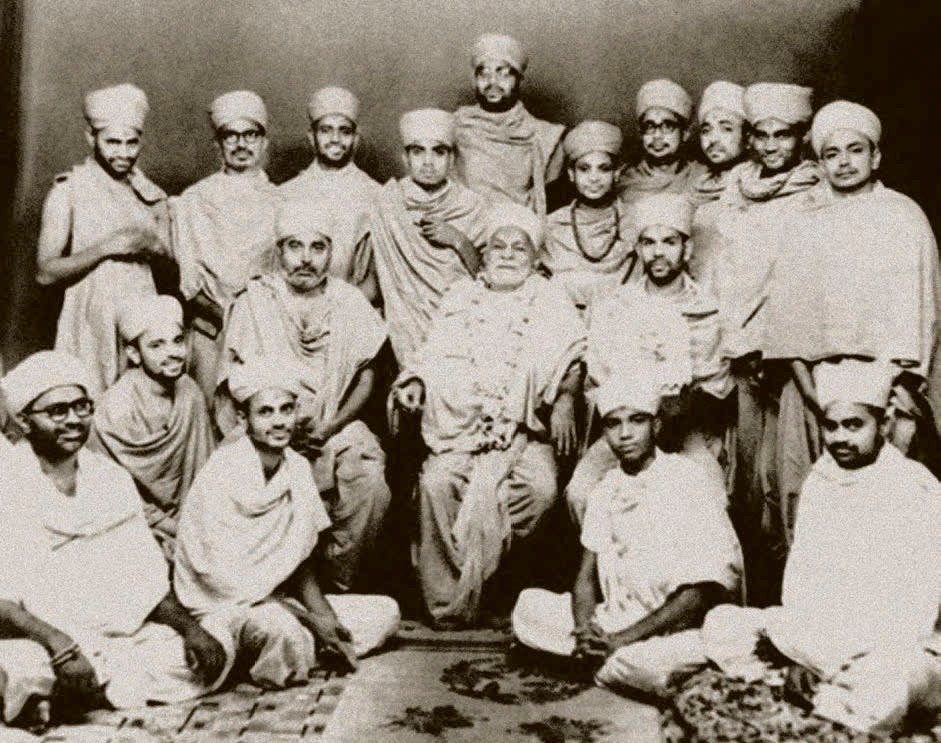
The trajectory of Vinubhai’s life shifted dramatically during his college years, specifically in 1951–1952. Following the passing of Shastriji Maharaj in 1951, Vinubhai’s family traveled to Sarangpur for the cremation rituals and subsequently to Gadhada for a Murti-Pratishtha ceremony. It was during this period that the young rationalist came into close contact with Yogiji Maharaj, the spiritual successor of Shastriji Maharaj.
Yogiji Maharaj was the antithesis of the “intellectual” scholar; he was effervescent, simple and overflowing with selfless love. This contrast captivated Vinubhai. He was struck by Yogiji Maharaj’s “spiritual charisma and selfless love.” The intellectual defenses began to crumble in the face of such pure divinity. Vinubhai began traveling with Yogiji Maharaj during his summer vacations, observing the Guru’s life at close quarters.
4.2 A Pivotal Train Journey
A defining moment occurred in 1951/1952 when Vinubhai was boarding a train from Anand for Janmashtami. It so happened that Pramukh Swami Maharaj (then a young Sadguru and President of BAPS) was on the same train. While other youths went to their compartments, Vinubhai joined Pramukh Swami Maharaj. During their conversation, Pramukh Swami Maharaj, in broken Hindi, asked him, “Why don’t you become a sadhu? You will do great seva in the future.” This direct question from a figure of such spiritual stature planted a seed. Vinubhai realized the deep and divine personality of Pramukh Swami Maharaj, feeling an immediate attraction and respect. This interaction, combined with the affection of Yogiji Maharaj, solidified his resolve.11
4.3 The Decision to Renounce
By 1956, after graduating, Vinubhai had made his choice. In a move that surprised many—given his education and potential career prospects—he decided to renounce the material world. On February 2, 1957, Yogiji Maharaj granted him Parshad Diksha (the probationary stage of monastic life) and renamed him Vinu Bhagat. Yogiji Maharaj was overjoyed, declaring to other youths, “Because of Vinubhai, 51 youths will take diksha. The punya [of that] will go to him”.
5. The Fire of Asceticism: The Test of Silence (1957–1961)
5.1 The “Silent” Test
The transition from a beloved devotee to a renunciate is often marked by spiritual testing. For Vinu Bhagat, this test was severe and psychological. From 1957 to 1960, he served as Yogiji Maharaj’s personal attendant. Prior to his diksha, Yogiji Maharaj had showered him with affection. However, for the first three months following his Parshad Diksha, Yogiji Maharaj completely withdrew his attention.
Yogiji Maharaj stopped speaking to Vinu Bhagat, did not look at him and acted as if he did not recognize him. For a disciple who had forsaken the world for his Guru’s love, this silence was a crushing weight. Yet, Vinu Bhagat did not waver. He did not question, “Why has he stopped talking to me?” Instead, he internalized the concept of Divyabhav—believing that the Guru’s actions, whether pleasant or painful, were divine and for his ultimate good.
5.2 Reconciliation at Bhavnagar
The test concluded in Bhavnagar on the night of Hari Jayanti. Both the Guru and the disciple were fasting. Unable to sleep due to the fast, Yogiji Maharaj woke up and approached Vinu Bhagat. He gently woke him and said, “Since neither of us can sleep, let’s do goshthi (spiritual discourse).” That night, the silence was broken. They conversed for hours. At the end, Yogiji Maharaj declared, “You have passed the test!” He blessed Vinu Bhagat with the spiritual merit (punya) of 178,000 malas, symbolically gifting him immense spiritual capital. This incident forged an unbreakable internal bond between them, teaching Vinu Bhagat that true connection with the Guru transcends speech and physical attention.
5.3 Early Service and Discipline
During this period, Vinu Bhagat was also tested in his service. He managed the daily correspondence, replying to letters on behalf of Yogiji Maharaj. This required him to align his thought process entirely with the Guru’s. He also engaged in menial service; in one instance, seeing a field littered with used datan (neem) sticks, he silently cleaned the entire field himself, demonstrating a humility that would later define his leadership.
6. Transition to Sadhu: The Birth of “Mahant Swami” (1961)
6.1 The Historic 1961 Diksha
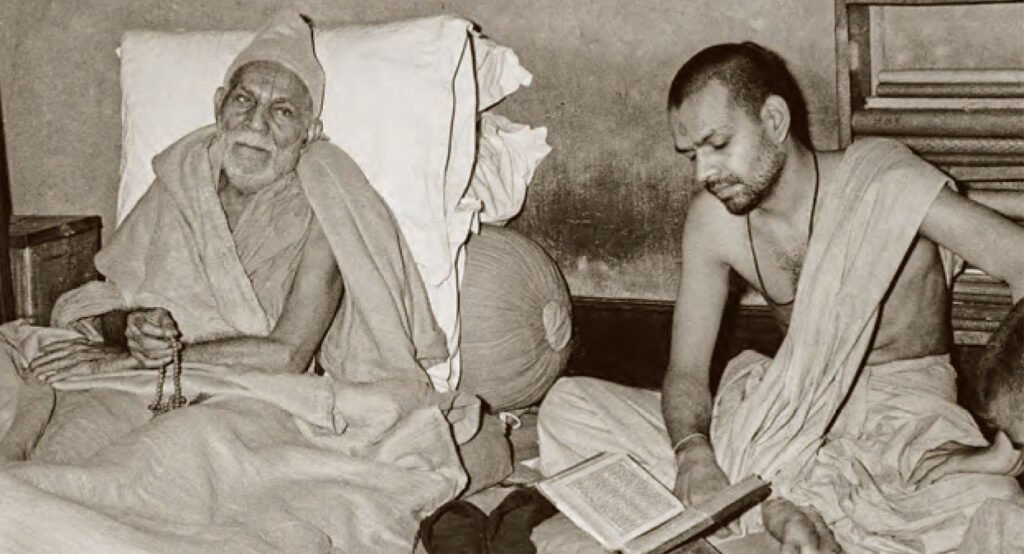
On May 11, 1961, a watershed moment occurred in the history of the Swaminarayan Sampradaya. In Gadhada, Yogiji Maharaj initiated 51 educated youths into the monastic order as saffron-clad sadhus (Bhagwati Diksha). This event was sociologically significant in post-independence India—51 young men, many with university degrees in engineering, agriculture and science, renouncing the world simultaneously to serve society and God.
Vinu Bhagat was the first among them to be initiated. He was given the name Sadhu Keshavjivandas. The name “Keshav” harkened back to the name Shastriji Maharaj had given him at birth, effectively closing a spiritual circle.
6.2 The Origin of the Title “Mahant Swami”
Following the initiation, Yogiji Maharaj had a specific vision for this group of educated sadhus. He instructed them to reside in Mumbai to study Sanskrit and scriptures deeply. To oversee this group and the activities of the BAPS Shri Swaminarayan Mandir in Dadar, Mumbai, Yogiji Maharaj appointed Sadhu Keshavjivandas as their group head or “Mahant.”
Because of this appointment, he began to be referred to as Mahant Swami. The title stuck, eventually becoming his primary identity within the fellowship. It signified not just administrative authority but his role as a “mother and father” to the younger sadhus. Yogiji Maharaj explicitly reinforced this to the youths, saying: “Mahant Swami is your mother and father! Follow his agna. Do as he says”.
6.3 Developing the “Mahant” Persona
During the 1960s, Mahant Swami’s relationship with Yogiji Maharaj deepened further.
- The “Mahaprasad” Incident: In 1965 in Mumbai, Yogiji Maharaj publicly transferred food from Mahant Swami’s bowl to another senior swami’s bowl, exclaiming, “You have received the Mahaprasad, Guru! Today your work is done.” Devotees interpreted this as a subtle indication of Mahant Swami’s spiritual elevation and communion with God.
- 1970 UK Visit: Mahant Swami accompanied Yogiji Maharaj on his historic visit to the UK in 1970, which resulted in the inauguration of the temple in Islington, London—the first Swaminarayan mandir in the Western Hemisphere. This exposure to the western diaspora laid the groundwork for his future global leadership.
7. Service Under Pramukh Swami Maharaj (1971–2016)
7.1 The Seamless Transition (1971)
When Yogiji Maharaj passed away in 1971, the spiritual mantle passed to Pramukh Swami Maharaj. For Mahant Swami, this transition was seamless. He transferred his devotion from Yogiji Maharaj to Pramukh Swami Maharaj instantly, embodying the BAPS principle that the Gunatit Guru is one continuous spiritual entity changing physical forms. From 1971 to 2016, Mahant Swami Maharaj served as a Sadguru (senior swami), working tirelessly under Pramukh Swami Maharaj’s leadership. His role was multifaceted and crucial for the organization’s expansion.
7.2 Role in Major Festivals and Youth Activities
Mahant Swami Maharaj played a pivotal role in the execution of BAPS mega-festivals, which are massive logistical undertakings.
- 1981 Bicentenary Celebrations: He was a key organizer for the Bhagwan Swaminarayan Bicentenary Celebrations in Ahmedabad, a 37-day festival that first showcased BAPS’s organizational capacity on a global stage.
- 1985 & 1992 Festivals: He continued to lead during the Bicentenary of Gunatitanand Swami (1985) and the Centenary of Yogiji Maharaj (1992).
- Youth Leadership: He was the primary inspiration for the Yuvak Mandals (Youth Forums). He traveled extensively to hold youth conventions (shibirs), where his logical yet deeply spiritual discourses resonated with the modern educated youth.
7.3 The “Quiet” Disciple
During these 45 years, Mahant Swami Maharaj was known for his reticence. He often sat in the background, avoiding the limelight. Yet, his spiritual stature was an open secret among the senior devotees.
- Humility in Action: In Bochasan, noticing his seat was elevated above the murti of Thakorji or his Guru’s memorial, he immediately ordered it to be lowered. In Sarangpur, he would often refuse to sit on the central seat even when authorized, preferring a side position to show respect to Pramukh Swami Maharaj.
- The 2012 Succession Letter: The succession plan was formalized years before Pramukh Swami Maharaj’s passing. On July 20, 2012, in Ahmedabad, Pramukh Swami Maharaj wrote a historic letter declaring that after his time, Sadhu Keshavjivandas (Mahant Swami) would be the Guru and President of BAPS. This letter was kept confidential and read publicly only after Pramukh Swami Maharaj passed away on August 13, 2016. This smooth transition prevented any ambiguity regarding leadership.
8. Philosophy in Action: The Era of Mahant Swami Maharaj (2016–Present)
Upon assuming the leadership in 2016, Mahant Swami Maharaj did not change the core theology but emphasized specific practical applications of the Akshar-Purushottam Darshan suited for the modern devotee. His teachings crystallize into four key pillars: Samp (Unity), Suhradbhav (Fraternity), Ekta (Oneness), and Dasbhav (Servitude).
8.1 The Theology of Unity (Samp)
Mahant Swami Maharaj’s central message is “Samp.” He famously stated during the construction of the Johannesburg temple: “Samp, Samp, Samp. If we keep samp, everything will be accomplished.” He teaches that internal discord is the greatest obstacle to spiritual progress. His approach to unity is theological: one must see others as “Akshar” (divine) and oneself as a servant, thereby eliminating the ego that causes conflict. He views unity not just as a social lubricant but as a spiritual mandate.
8.2 Radical Humility (Dasbhav)
If Pramukh Swami Maharaj was the “People’s Guru” who built massive institutions, Mahant Swami Maharaj is often seen as the “Saint of Silence” whose humility is his loudest message.
- The 71 Dandvats: On Janmashtami (August 25, 2016), shortly after becoming Guru, the 82-year-old Mahant Swami Maharaj performed 71 dandvats (full body prostrations) in a single day across Bochasan, Chansad and Atladra. This physical feat, performed to honor his Guru and God, was a demonstration of devotion that defied his age and frail health.
- Interactions with Devotees: He often tells children and devotees, “I should bow to you,” reversing the traditional hierarchy. In Robbinsville, when a youth dressed as a statue moved, Mahant Swami’s instinct was to bow to him, seeing the divinity within the youth rather than the error.6
8.3 “Divyabhav” (Perceiving Divinity)
Mahant Swami Maharaj teaches devotees to see divinity in everyone—not just the Guru, but in fellow devotees and even in adverse situations. He advocates that “Nirdosh Budhhi” (finding no fault in others) is the gateway to Akshardham. This teaching is a direct antidote to the cynicism of the modern age.
9. Monumental Achievements: Temple Creation and Global Incentives
Under Mahant Swami Maharaj’s leadership, BAPS has completed some of its most ambitious projects, fulfilling the visions of his predecessors while expanding into new geopolitical territories.
9.1 BAPS Swaminarayan Akshardham, Robbinsville, NJ (USA)
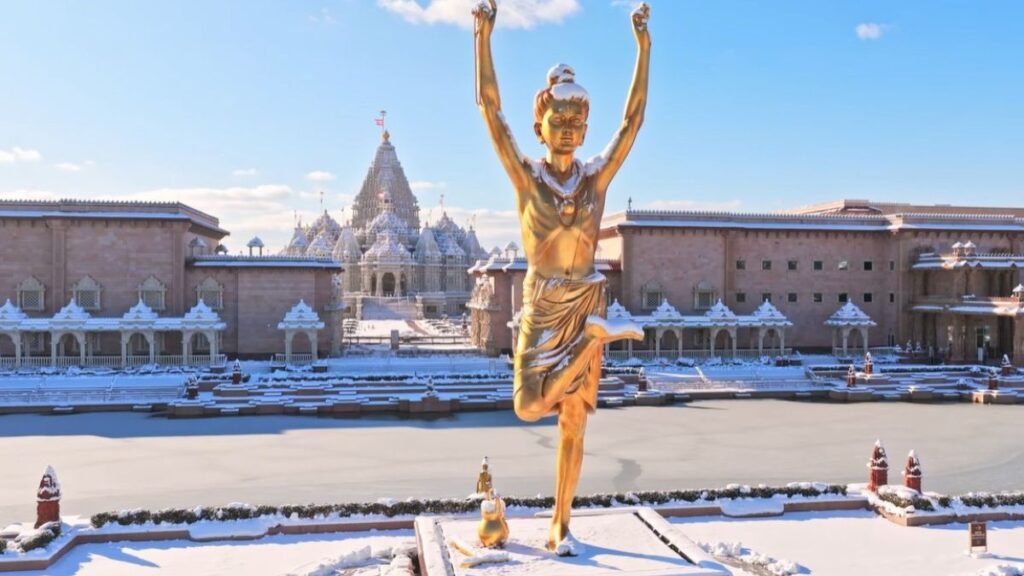
The Akshardham in Robbinsville, inaugurated in October 2023, is the magnum opus of the Hindu diaspora. It is the largest Hindu temple in the Western Hemisphere. Mahant Swami Maharaj oversaw the final, critical years of its construction.
- The “Festival of Inspirations”: In 2023, he spent three months in Robbinsville for the “Festival of Inspirations,” guiding the final phase.
- Significance: He emphasized that the temple is a place to “mold one’s life,” not just stone. He personally performed the installation of the pillars and engaged with the thousands of volunteers (Karyakars) who built the complex, calling them the “heart” of the project.
9.2 BAPS Hindu Mandir, Abu Dhabi (UAE)
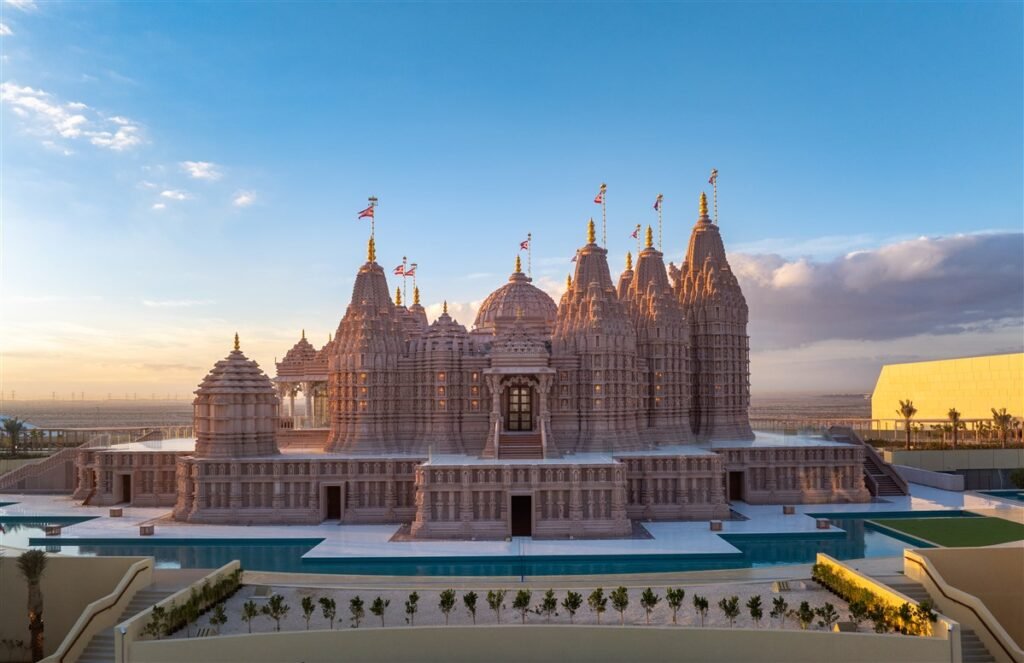
Perhaps the most geopolitically significant achievement is the BAPS Hindu Mandir in Abu Dhabi, the first traditional stone Hindu temple in the Middle East.
- The Vision: Initiated by Pramukh Swami Maharaj in 1997, it came to fruition under Mahant Swami Maharaj.
- The Letter of Harmony: In December 2020, amidst the COVID-19 pandemic, Mahant Swami Maharaj wrote a handwritten letter for the temple’s “Shilanyas” (foundation) ceremony. He articulated that the temple would be a “spiritual oasis for global harmony,” transcending religious boundaries.
- Completion: The temple was inaugurated by Indian Prime Minister Narendra Modi in February 2024, with Mahant Swami Maharaj presiding. It stands as a symbol of interfaith tolerance and diplomatic success between India and the UAE.1
9.3 BAPS Mandir, Paris (France)
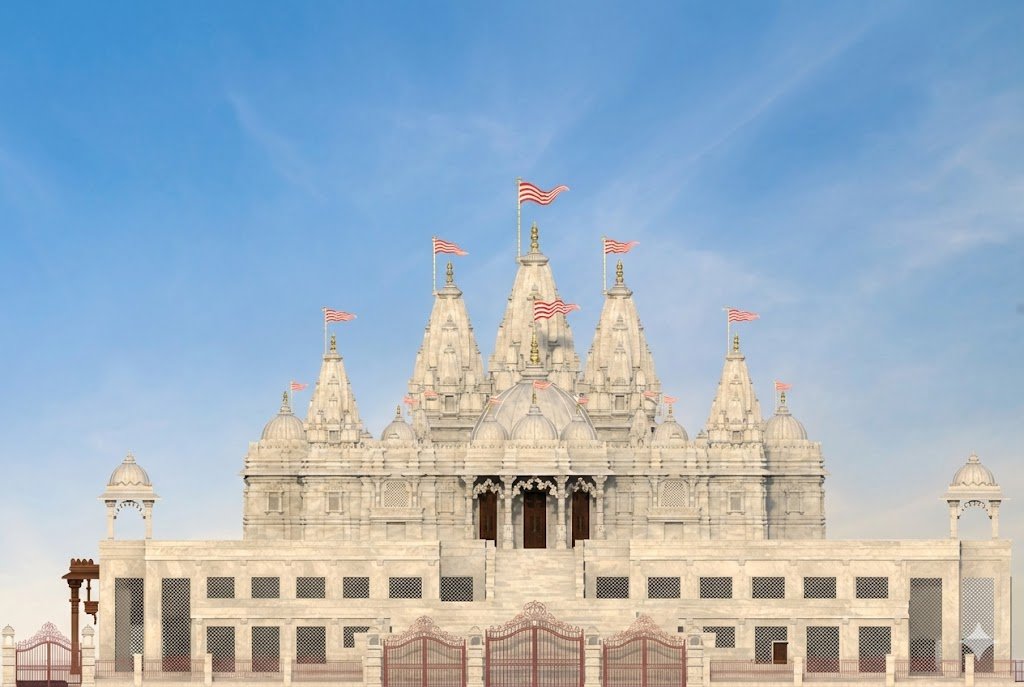
Currently under construction, the Paris Mandir is set to be the first traditional Hindu stone temple in France, located in Bussy-Saint-Georges.
- Progress: The “Shilanyas” (foundation stone laying) was performed in September 2022. As of early 2026, the temple construction is advanced, utilizing stones carved in India and assembled in Paris.
- Cultural Fusion: The project involves collaboration between Indian artisans and French stonemasons (some of whom worked on the restoration of Notre Dame), symbolizing a unique architectural and cultural fusion.
9.4 BAPS Mandir, Johannesburg (South Africa)
The Johannesburg temple, nearing completion in 2025/2026, will be the largest Hindu temple complex in the Southern Hemisphere.
- Themes: The project focuses on sustainability and community service.
- Murti-Pratishtha: The consecration ceremonies (Murti-Pratishtha) were scheduled for early 2025. Mahant Swami Maharaj has provided continuous blessings for this project, which aims to be a hub for the entire African continent.
9.5 Timeline of Key Projects Under Mahant Swami Maharaj
| Year | Project/Event | Location | Significance |
| 2017 | Groundbreaking (Shilanyas) | Johannesburg & Sydney | Expansion into Africa and Australia. |
| 2019 | Foundation Ceremony | Abu Dhabi, UAE | First traditional stone temple in Middle East. |
| 2022 | Shatabdi Mahotsav | Ahmedabad, India | Centenary of Pramukh Swami Maharaj (600-acre temporary city). |
| 2023 | Akshardham Inauguration | Robbinsville, NJ | Largest Hindu temple in Western Hemisphere. |
| 2024 | Mandir Inauguration | Abu Dhabi, UAE | Historic interfaith milestone. |
| 2025 | Murti-Pratishtha | Johannesburg, SA | Largest temple in Southern Hemisphere. |
| 2026 | 92nd Janma Jayanti | Atladra, India | Major devotee gathering (upcoming). |
10. Humanitarian and Social Incentives
Mahant Swami Maharaj has continued and expanded the humanitarian footprint of BAPS, focusing on three core areas: De-addiction, Environment and Education/Tribal Upliftment.
10.1 De-Addiction Campaigns (Vyasan Mukti)
Building on the legacy of Pramukh Swami Maharaj, Mahant Swami Maharaj has mobilized children and youth for massive de-addiction drives.
- 2022 Campaign: To commemorate Pramukh Swami Maharaj’s centennial and India’s “Azadi Ka Amrit Mahotsav,” 16,000 children contacted over 1.4 million people across India in May 2022.
- Impact: Over 400,000 individuals pledged to give up addictions (alcohol, tobacco, drugs). This grassroots approach utilizes the innocence of children to effect social change in households that adults often cannot reach. The campaign saved families an estimated millions of rupees in future addiction costs and promoted domestic peace.
10.2 Environmental Stewardship
Mahant Swami Maharaj advocates for “taking care of the environment” as a form of devotion.
- Tree Planting: BAPS conducts massive tree-planting drives globally. In 2020, he initiated a specific campaign where devotees performed pujan (worship) of plants to instill reverence for nature.
- Green Temples: New temples, including Robbinsville and Johannesburg, integrate solar power and water conservation systems. The Johannesburg complex, for example, prioritizes water efficiency and includes the planting of over 500 indigenous trees.
10.3 Tribal Upliftment and Sanskrit Education
In the tribal belts of Gujarat and Maharashtra, BAPS runs schools, mobile medical vans and de-addiction centers.
- Sanskrit Shloka Mukhapath Abhiyan: A new initiative under Mahant Swami Maharaj is the massive Sanskrit learning drive. Over 37,000 children have registered to memorize verses from the Satsang Diksha text. This initiative aims to preserve the ancient language and cultural values among the younger generation.
- Tribal Development: The organization maintains over 209 centers in tribal areas to combat superstition and illiteracy, providing educational and medical aid to marginalized communities.34
11. The 92nd Janma Jayanti Mahotsav: Atladra 2026
The upcoming 92nd birthday celebration (Janma Jayanti) of Mahant Swami Maharaj is a focal point for the global devotee base in early 2026. This event is not just a birthday celebration but a spiritual congregation reaffirming the bond between the Guru and the disciple.
11.1 Significance of Atladra
The choice of Atladra (Vadodara) for the 92nd Janma Jayanti is historically resonant. Atladra is home to one of the seminal mandirs built by Shastriji Maharaj in 1945. It is a place where Mahant Swami Maharaj spent significant time as a young sadhu and later as a Sadguru. The soil of Atladra is steeped in the history of the Sampradaya, making it a fitting venue for this milestone.
11.2 Event Details and Logistics
Date: Monday, February 2, 2026
Time: 5:00 PM to 8:00 PM (Entry begins at 3:00 PM)
Venue: Near A.P.M.C. Market, National Highway No. 48, Vadodara.
Critical Logistical Instructions for Devotees:
- Direct Arrival: Devotees have been strictly instructed not to visit the Atladra Mandir or the Chansad Mandir (Pramukh Swami Maharaj’s birthplace) on the day of the festival. There are no parking or dining arrangements at those sites to handle the massive influx. All attendees must proceed directly to the Mahotsav venue on the highway.
- Accommodation: The registration for accommodation (Utara) closed on January 20, 2026. Accommodation was provided only for devotees from outside Gujarat (Parprant) and abroad (Pardesh), available from February 1st. Gujarat and Mumbai devotees are expected to make day trips.
- Vulnerable Groups: Very elderly and frail devotees are advised to watch the live broadcast from home to avoid the massive crowds and physical strain.
11.3 Themes: “Ocean of Virtues” and “Sant Param Hitkari”
The celebrations leading up to the 2026 event have been themed around Mahant Swami Maharaj’s qualities, preparing the devotees spiritually for the main event.
- UK & Europe Precursor (late 2025): The theme “Ocean of Virtues” highlighted six specific qualities:
- Ocean of Presence (omnipresence through spiritual connection).
- Ocean of Selflessness (service before self).
- Ocean of Embracement (accepting all).
- Ocean of Humility (Dasbhav).
- Ocean of Spirituality (God-centric life).
- Ocean of Love (unconditional care).
- North America: Celebrations reflected the theme “Sant Param Hitkari” (A Saint who works for the eternal good of all), focusing on his role as a guide (Sacha Margdarshak) and his tireless travels (Vicharan).
11.4 The “Mahotsav” Experience
The event on February 2nd represents the culmination of these themes. It will feature:
- Cultural Programs: Skits, traditional dances and video presentations depicting his life work.
- Spiritual Discourses: Senior Swamis will expound on his virtues and the importance of the Guru.
- Guruhari Darshan: The climax of the event will be the darshan and blessings of Mahant Swami Maharaj himself, a moment cherished by devotees as “Smruti”.
12. Devotee Experiences: The “Quiet” Charisma
The true measure of Mahant Swami Maharaj’s influence lies in the personal experiences (Smrutis) of his devotees. Unlike leaders who command from a distance, Mahant Swami Maharaj is known for his microscopic attention to detail and personal care. These “Prasangs” (divine incidents) form the oral tradition of the fellowship.
12.1 The “Prasangs” (Divine Incidents)
- The Datan Stick Incident: As a young sadhu, he once saw a field littered with used datan (neem) sticks. Without ordering anyone, he silently began picking them up. When others rushed to stop him, he insisted they join him, teaching by example rather than precept.
- Akshardham’s “Passport”: Devotees often recount moments where he humorously yet profoundly assures them of liberation. In Wembley, he famously stamped a devotee’s “passport” to Akshardham through his divine gaze, a metaphor for the Guru’s promise of Moksha.
- Connection with APJ Abdul Kalam: The late President of India, Dr. APJ Abdul Kalam, wrote Transcendence about his experiences with Pramukh Swami Maharaj. At the book launch, Mahant Swami Maharaj’s presence and blessings were noted by Kalam and others as carrying the same spiritual weight as his predecessor, solidifying the continuity of the Gunatit state.
12.2 Smruti: The Power of Memory
For BAPS devotees, “Smruti” (recollection of divine memories) is a spiritual discipline. Mahant Swami Maharaj encourages this by recounting his own memories of Yogiji Maharaj and Pramukh Swami Maharaj with photographic detail. He teaches that remembering the Guru’s actions purifies the mind. His own “Dinacharya” (daily routine)—waking before dawn, extensive puja and constant writing of letters—serves as a template for devotees’ discipline. The practice of “Smruti” allows devotees to feel the Guru’s presence even when they are physically distant.
13. Conclusion: The Legacy of Silence
In an era of loud voices and aggressive self-promotion, Mahant Swami Maharaj stands as a paradox: a leader of millions who speaks in whispers, a builder of monumental temples who prefers the corner seat. His legacy is not just in the stone structures of Abu Dhabi or Robbinsville, but in the internal architecture of the devotees he leads.
He has successfully navigated the BAPS Swaminarayan Sanstha through a critical transition post-2016, proving that the organization’s strength lies not in the personality of a single leader, but in the spiritual lineage that connects them. As he approaches his 92nd birthday in Atladra, Mahant Swami Maharaj remains the “Quiet Visionary”—a figure who, through unity, humility and absolute devotion, continues to lead a global Hindu movement toward a future defined by spiritual depth and social service.
For the millions of followers gathering in Atladra or watching from their homes in London, Nairobi and New Jersey, he is more than a leader; he is the “Pragat Satpurush”—the living form of the divine, guiding them home to Akshardham.
Key Statistical Summary
| Category | Detail |
| Birth Name | Vinubhai Patel (Keshav) |
| Birth Date | September 13, 1933 |
| Birthplace | Jabalpur, Madhya Pradesh, India |
| Education | B.Sc. Agriculture (Anand, 1956) |
| Diksha | Parshad (1957), Bhagwati (1961 – First of 51 Sadhus) |
| Guru Succession | 6th Spiritual Successor of Bhagwan Swaminarayan |
| Key Projects | Akshardham Robbinsville, BAPS Hindu Mandir Abu Dhabi, Paris Mandir |
| Upcoming Major Event | 92nd Janma Jayanti, Feb 2, 2026, Atladra (Vadodara) |
| Core Teachings | Samp (Unity), Dasbhav (Servitude), Divyabhav (Divinity) |
| Global Network | 1,200+ Mandirs, 80,000+ Volunteers |
Report filed for WorldMajorEvents
Date: January 30, 2026–
Works cited
- Bochasanwasi Akshar Purushottam Swaminarayan Sanstha – Wikipedia, accessed January 29, 2026, https://en.wikipedia.org/wiki/Bochasanwasi_Akshar_Purushottam_Swaminarayan_Sanstha
- Humanitarian Services – BAPS, accessed January 29, 2026, https://www.baps.org/humanitarianservices.aspx
- Mahant Swami Maharaj – BAPS Swaminarayan Sanstha, accessed January 29, 2026, https://na.baps.org/learn/our-beliefs/guru-parampara/mahant-swami-maharaj
- Festival of Inspirations – Introducing BAPS Swaminarayan Akshardham, accessed January 29, 2026, https://usa.akshardham.org/foi/akshardham
- Mahant Swami Maharaj – Wikipedia, accessed January 29, 2026, https://en.wikipedia.org/wiki/Mahant_Swami_Maharaj
- Holding the Hand of the Guru: Life Lessons from Mahant Swami Maharaj, accessed January 29, 2026, https://bapssatsangeng.medium.com/holding-the-hand-of-the-guru-life-lessons-from-mahant-swami-maharaj-2a01e42c9416
- Mahant Swami Maharaj: BAPS Leader | PDF | Theistic Indian Philosophy – Scribd, accessed January 29, 2026, https://fr.scribd.com/document/517854449/9-Mahant-Swami-Maharaj
- Life – MSM 2023, accessed January 29, 2026, https://msm.neasdentemple.org/portfolio/life/
- Mahant Swami Maharaj – National Hindu Students’ Forum (UK), accessed January 29, 2026, https://www.nhsf.org.uk/2016/10/mahant-swami-maharaj/
- A Brief History – BAPS, accessed January 29, 2026, https://www.baps.org/About-BAPS/TheFounder%E2%80%93BhagwanSwaminarayan/TheSpiritualLineage-TheGuruParampara/Mahant-Swami-Maharaj/A-Brief-History.aspx
- Mahant swami- Life sketch – Mahi Patel – Prezi, accessed January 29, 2026, https://prezi.com/p/2wsadoiortrd/mahant-swami-life-sketch/
- North America Adhiveshan 2025 – Satsang Prasang – Anirdesh.com, accessed January 29, 2026, https://anirdesh.com/smadhiveshan25/prasang.php?prasang=90&format=Eng
- A Life of Seva. Seva refers to the selfless actions and… | by Param Shanti | BAPS Swaminarayan Satsang | Medium, accessed January 29, 2026, https://medium.com/bapssatsang/a-life-of-seva-b4b1123027b2
- Mahant Swami Maharaj – Prasangs and Inspirations, accessed January 29, 2026, https://mahantswami.wordpress.com/
- Life and times of Mahant Swami Maharaj – News India Times, accessed January 29, 2026, https://newsindiatimes.com/life-and-times-of-mahant-swami-maharaj/
- Principles of Satsang: (Part 2) Samp, Suhradbhav and Ekta – BAPS Swaminarayan Sanstha, accessed January 29, 2026, https://www.baps.org/EnlighteningEssays/2011/Principles-of-Satsang-(Part-2)-Samp-Suhradbhav-and-Ekta-2092.aspx
- Mahant Swami Maharaj – An epitome of humility – The South Asian Times, accessed January 29, 2026, https://thesouthasiantimes.info/Spiritual-Awareness/news/mahant-swami-maharaj-an-epitome-of-humility/1772
- Mahant Swami Maharaj: Embodying Humility | दासभाव – YouTube, accessed January 29, 2026, https://www.youtube.com/watch?v=aN2tMOkVA34
- Faith in Guru: A Beacon of Transformation | Festival of Inspirations – BAPS Swaminarayan Akshardham, accessed January 29, 2026, https://usa.akshardham.org/foi/g/faith-in-guru-a-beacon-of-transformation
- His Holiness Mahant Swami Maharaj Recognized for Achievement in Building Better Communities, USA – BAPS, accessed January 29, 2026, https://www.baps.org/News/2025/His-Holiness-Mahant-Swami-Maharaj-Recognized-for-Achievement-in-Building-Better-Communities-29934.aspx
- THE LETTER: The Handwritten Destiny of Abu Dhabi Mandir – YouTube, accessed January 29, 2026, https://www.youtube.com/watch?v=8F-SRHsjz2Y
- News – BAPS, accessed January 29, 2026, https://www.baps.org/news.aspx?view=all
- BAPS Swaminarayan Hindu Mandir, Paris: Home, accessed January 29, 2026, https://www.bapsmandirparis.fr/
- BAPS dispatches first sacred stones from India for France’s 1st traditional Hindu Mandir, accessed January 29, 2026, https://ianslive.in/baps-dispatches-first-sacred-stones-from-india-for-frances-1st-traditional-hindu-mandir–20260127161804
- Progress of the Traditional Hindu Temple BAPS Paris – Construction by Arte Charpentier, accessed January 29, 2026, https://www.arte-charpentier.com/en/progress-of-the-traditional-hindu-temple-baps-paris-construction-by-arte-charpentier/
- Construction Update: June 2025 | BAPS Swaminarayan Hindu Mandir, Paris – YouTube, accessed January 29, 2026, https://www.youtube.com/watch?v=5eqEcb245ec
- BAPS Johannesburg | The Largest Hindu Temple Complex In The Southern Hemisphere To Be Ready By 2027 – YouTube, accessed January 29, 2026, https://www.youtube.com/watch?v=C8A1dF0-WJA
- Largest Hindu Temple and Cultural Complex in the Southern Hemisphere to open in Joburg, accessed January 29, 2026, https://propertywheel.co.za/2025/01/largest-hindu-temple-and-cultural-complex-in-the-southern-hemisphere-to-open-in-joburg/
- BAPS South Africa, accessed January 29, 2026, https://www.baps.org.za/
- De-Addiction Campaign by BAPS Children, India, accessed January 29, 2026, https://www.baps.org/News/2022/De-Addiction-Campaign-by-BAPS-Children-21435.aspx
- PSM100: De-addiction Day: Celebrating Transformation, Ahmedabad, India – BAPS, accessed January 29, 2026, https://www.baps.org/News/2022/PSM100-De-addiction-Day-Celebrating-Transformation-22899.aspx
- Honoring Nature – Taking Care of the Environment – BAPS, accessed January 29, 2026, https://www.baps.org/Photos/2020/Taking-Care-of-the-Environment-22343.aspx?mid=212225
- Honoring Nature – Taking Care of the Environment – BAPS, accessed January 29, 2026, https://www.baps.org/News/2020/Honoring-Nature—Taking-Care-of-the-Environment-19067.aspx
- Transforming young lives through eternal culture: BAPS begins Sanskrit learning initiative, accessed January 29, 2026, https://www.thehansindia.com/news/national/transforming-young-lives-through-eternal-culture-baps-begins-sanskrit-learning-initiative-992122
- Activities of BAPS – Tribal Care – Tribal Upliftment – || B A P S Swaminarayan Sanstha ||, accessed January 29, 2026, http://www.swaminarayan.org/activities/tribal/tribalupliftment.htm
- 92nd Janma Jayanti Accommodation 2026, Atladara – BAPS, accessed January 29, 2026, https://www.baps.org/Global-Network/India/Atladra/92nd-Janma-Jayanti-Accommodation-2026.aspx
- Atladra Mandir BAPS – Prezi, accessed January 29, 2026, https://prezi.com/p/ilggbk7eq2dq/atladra-mandir-baps/
- HH Mahant Swami Maharaj Janma Jayanti – BAPS, accessed January 29, 2026, https://www.baps.org/Announcement/2025/HH-Mahant-Swami-Maharaj-Janma-Jayanti-28853.aspx
- HH Mahant Swami Maharaj’s 92nd Birth Anniversary Celebration, Atladara (Vadodara), India – BAPS, accessed January 29, 2026, https://www.baps.org/Announcement/2026/HH-Mahant-Swami-Maharajs-92nd-Birth-Anniversary-Celebration-30786.aspx
- Mahant Swami Maharaj 92nd Janma Jayanti Celebrations, UK & Europe – BAPS, accessed January 29, 2026, https://www.baps.org/News/2025/Mahant-Swami-Maharaj-92nd-Janma-Jayanti-Celebrations-29232.aspx
- HH Mahant Swami Maharaj’s 92nd Birthday Celebrations, North America – BAPS, accessed January 29, 2026, https://www.baps.org/News/2025/HH-Mahant-Swami-Maharajs-92nd-Birthday-Celebrations-29285.aspx
- Transcendence: My Spiritual Experiences with Pramukh Swamiji – Wikipedia, accessed January 29, 2026, https://en.wikipedia.org/wiki/Transcendence:_My_Spiritual_Experiences_with_Pramukh_Swamiji
- ‘Transcendence’ – Celebrating the Historic Book by Dr APJ Abdul Kalam on H.H. Pramukh Swami Maharaj, Ahmedabad, India – BAPS, accessed January 29, 2026, https://www.baps.org/News/2015/Transcendence—Celebrating-the-Historic-Book-by-Dr-APJ-Abdul-Kalam-on-HH-Pramukh-Swami-Maharaj-8159.aspx
- Dr. APJ Abdul Kalam Book On HH Pramukh Swami Maharaj Released – Hinduism Today, accessed January 29, 2026, https://www.hinduismtoday.com/hpi/2015/07/05/dr-apj-abdul-kalam-book-on-hh-pramukh-swami-maharaj-released/
- Ayurveda Daily Routine: Balance Vata, Pitta & Kapha, accessed January 29, 2026, https://ayurveda.com/the-daily-routine/
- Mahant Swami’s Smruti Techniques | PDF | Bhakti Movement – Scribd, accessed January 29, 2026, https://www.scribd.com/document/823087965/Gr2U1-PV-First-Meeting-Lasting-Smruti
- Smruti Yatra: Anniversary of His Holiness Mahant Swami Maharaj’s 2023 visit to Canada, accessed January 29, 2026, https://www.baps.org/News/2024/Smruti-Yatra-26140.aspx