




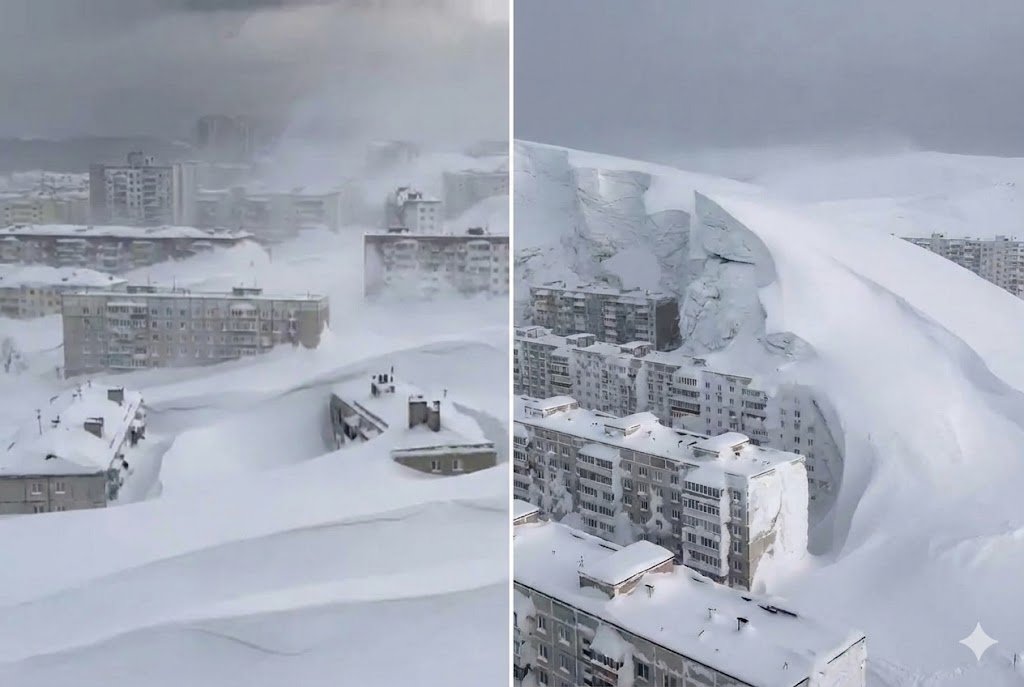
Kamchatka, Russia – Russia’s remote Far East has been plunged into chaos after record-breaking snowfall buried entire cities in the Kamchatka Peninsula, killing at least two people, trapping residents inside buildings, and forcing authorities to declare a state of emergency across several districts.
The extreme winter event, described by locals as a “snow apocalypse,” has shattered decades-old and in some cases, century-old weather records, with snowfall levels unseen in more than 130 years, according to meteorological data and Russian emergency officials.
Entire Neighbourhoods Disappear Under Snow
In dramatic images and videos shared widely on social media and international news platforms, multi-storey apartment buildings are buried up to the fourth floor, vehicles are almost completely submerged and streets have vanished beneath towering snowdrifts.
In the regional capital Petropavlovsk-Kamchatsky, residents were seen climbing out of windows, digging tunnels to reach the outside and using ladders to escape snowbound homes. In several towns, doors were rendered unusable, forcing people to exit buildings through higher floors.
Local authorities confirmed that two people died during snow-clearing operations, while dozens were injured, many suffering from hypothermia, falls or exhaustion during rescue efforts.
Sea of Okhotsk Cyclones Trigger Historic Event
Meteorologists say the disaster was triggered by a rare convergence of powerful cyclones from the Sea of Okhotsk, which stalled over Kamchatka and unleashed relentless snowfall for days.
Some areas recorded multiple metres of snow accumulation in less than a week, overwhelming infrastructure and emergency services. Weather agencies reported that January snowfall totals alone exceeded average annual levels, marking this as one of the most extreme winter events in modern Russian history.
Experts warn that climate volatility is increasing the frequency of such extreme weather events, even in regions accustomed to harsh winters.
State of Emergency Declared
The Kamchatka regional government declared a state of emergency, allowing authorities to mobilise additional resources, including:
- Military snow-clearing equipment
- Heavy-duty bulldozers and excavators
- Emergency shelters and heating centres
- Food and medical supply distribution
Schools, universities and government offices have been shut indefinitely, while flights and ferry services have faced widespread cancellations due to whiteout conditions and unsafe runways.
Residents have been urged to stay indoors, conserve heating supplies and avoid unnecessary travel.
Daily Life Grinds to a Halt
Basic services have been severely disrupted:
- Power outages reported in multiple districts
- Ambulances delayed by impassable roads
- Supermarkets struggling to restock supplies
- Public transport suspended across major towns
Despite the devastation, moments of resilience and even joy have emerged. Videos show children skiing down snow-covered staircases, residents sliding down drifts and locals helping neighbours clear paths using shovels and makeshift tools.
Rescue Efforts Continue Around the Clock
Emergency workers are operating 24/7, battling exhaustion and extreme cold as snowfall continues intermittently. Authorities say clearing operations may take weeks, not days, due to the sheer volume of snow.
Officials have warned that roof collapses pose a serious risk, urging residents to report unstable structures immediately.
A Stark Reminder of Climate Extremes
Environmental analysts note that while Kamchatka is no stranger to brutal winters, the scale and intensity of this storm are unprecedented.
“This event goes far beyond seasonal norms,” one climate expert said. “It highlights how extreme weather patterns are becoming more erratic, even in regions historically adapted to cold.”
Global Attention on Kamchatka
The disaster has drawn international attention, with footage trending worldwide and major global news outlets calling it one of the most visually striking weather disasters of the decade.
As Kamchatka digs out from beneath mountains of snow, the focus now turns to recovery, rebuilding, and preparing for what could be a new era of extreme winters.