


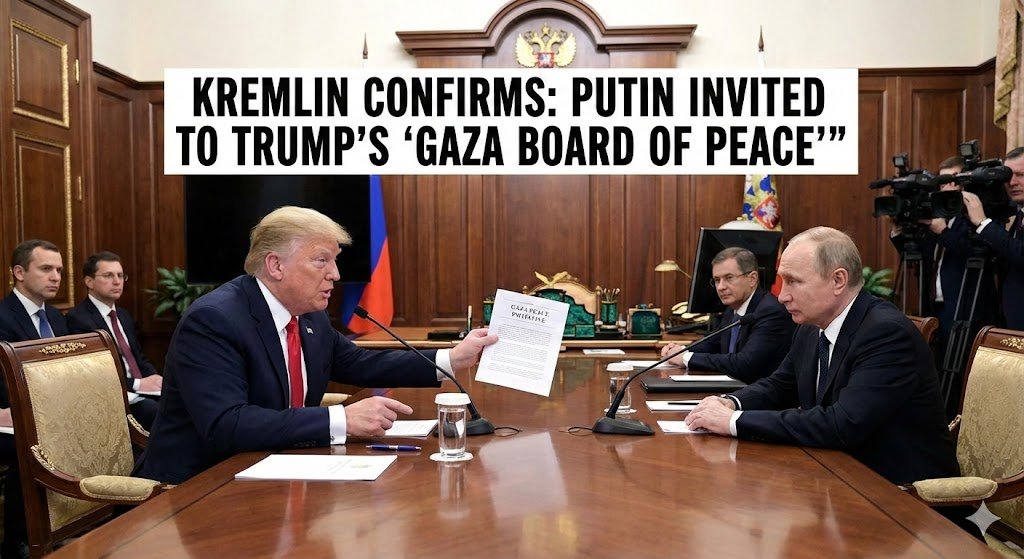
Russian President Vladimir Putin has been invited to join a proposed “Gaza Board of Peace” initiated by former U.S. President Donald Trump, the Kremlin confirmed on Monday, triggering intense global debate over diplomacy, geopolitics and the future of conflict resolution in the Middle East.
The invitation, first disclosed by Kremlin spokesperson Dmitry Peskov, comes at a time when Russia remains deeply embroiled in the war in Ukraine, raising questions about the political intent, credibility and potential impact of Trump’s proposed peace initiative.
What Is Trump’s Gaza “Board of Peace”?
According to multiple diplomatic and media sources, the Gaza Board of Peace is envisioned as an informal international advisory council proposed by Donald Trump, who is seeking to reassert his role as a global deal-maker ahead of the 2026 U.S. political cycle.
The board is reportedly intended to:
- Advise on ending the Israel-Hamas war
- Shape post-war governance in Gaza
- Promote regional security arrangements
- Explore long-term peace frameworks involving major global powers
While no official charter or member list has been published, Trump has publicly suggested that global leaders with “real influence” should be involved — including Russia’s president.
Kremlin Confirms the Invitation
Speaking to reporters in Moscow, Peskov confirmed that Putin had indeed received an invitation, saying the Kremlin was “aware of the proposal” and would evaluate it based on Russia’s strategic interests.
“Such initiatives require careful analysis,” Peskov said, adding that Russia has consistently supported diplomatic solutions in the Middle East.
However, he stopped short of confirming whether Putin would accept the offer.
Why Putin’s Inclusion Is Controversial
The invitation has immediately drawn sharp reactions across Europe, the United States and Ukraine.
Key concerns include:
- Russia’s ongoing invasion of Ukraine, now in its fourth year
- Western sanctions imposed on Moscow
- Allegations of war crimes against Russian forces
- Putin’s strained relations with NATO and the EU
Critics argue that inviting Putin undermines international efforts to isolate Russia diplomatically.
A senior European diplomat, speaking anonymously, described the move as “deeply problematic,” saying it risks “normalizing aggression while a major war continues on European soil.”
Trump’s Strategy: Diplomacy or Political Theater?
Supporters of Trump argue that his approach reflects pragmatic realism, not ideology.
Trump has long claimed that direct engagement with powerful leaders, even adversaries, is essential for conflict resolution. During his presidency, he pursued dialogue with North Korea, Russia and Middle Eastern powers outside traditional diplomatic channels.
Political analysts suggest the Gaza peace board could serve multiple purposes:
- Reinforcing Trump’s image as a global negotiator
- Differentiating him from current U.S. foreign policy
- Appealing to voters frustrated with endless wars
However, others see it as an attempt to sideline established diplomatic institutions such as the United Nations.
Global Reaction: Divided and Cautious
United States
U.S. officials have not formally endorsed the proposal. Several lawmakers warned that any peace effort involving Putin must account for Russia’s actions in Ukraine.
Europe
European leaders have expressed skepticism, with some privately questioning the legitimacy of a peace body led by a former president outside official state authority.
Middle East
Reactions in the Middle East have been mixed. Some regional analysts note that Russia maintains working relations with Israel, Iran,and Arab states — potentially positioning Moscow as a mediator.
Ukraine
Kyiv reacted sharply, with Ukrainian officials calling the invitation “morally unacceptable” while Russia continues military operations against Ukraine.
Will Putin Accept?
At this stage, the Kremlin says no decision has been made. Russian analysts suggest Putin may weigh:
- The opportunity to re-enter global diplomacy
- Potential backlash from the West
- Domestic political optics
- Strategic leverage in Middle East negotiations
Participation could allow Moscow to project itself as a peace broker, despite international criticism.
What This Means for Gaza and Global Diplomacy
The Gaza conflict has killed tens of thousands and destabilized the wider region. While any credible peace effort is urgently needed, experts caution that symbolic initiatives without institutional backing may struggle to deliver results.
Whether Trump’s Gaza Board of Peace becomes a serious diplomatic platform or remains a political concept will depend on:
- Who else joins
- Whether regional stakeholders engage
- The position of the U.S. government
- Russia’s final decision
The Bigger Picture
This development highlights a shifting global landscape where traditional diplomacy increasingly overlaps with political branding, unofficial channels and personal leadership networks.
As wars in Gaza and Ukraine continue to reshape international order, the question is no longer just who makes peace — but who is trusted to do so.
WorldMajorEvents will continue to track reactions, confirmations, and developments surrounding Trump’s proposed peace board and Vladimir Putin’s response.