




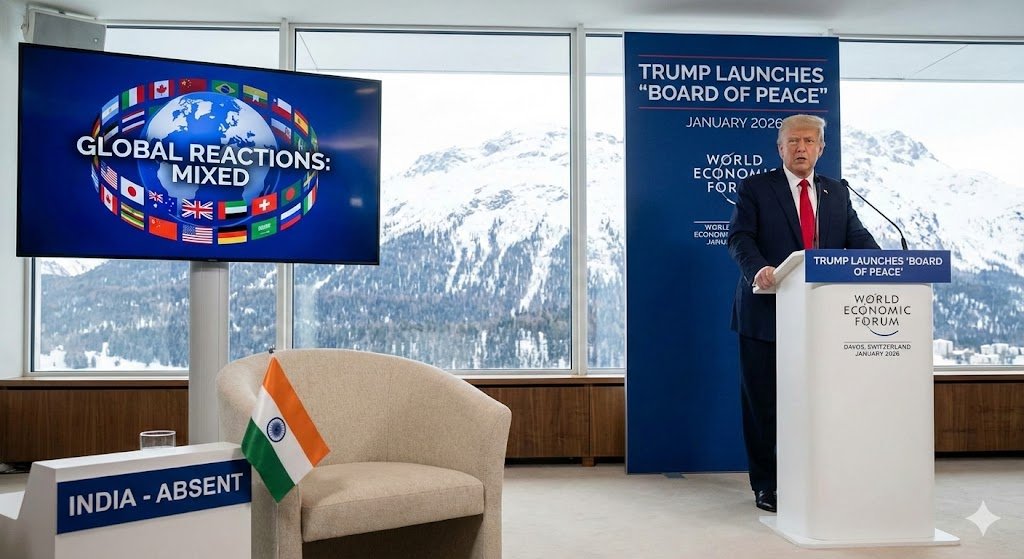
DAVOS, Switzerland — In a headline-making diplomatic move at the World Economic Forum 2026, former U.S. President Donald Trump publicly launched the “Board of Peace” — a new international peace and conflict-resolution initiative aimed initially at Gaza reconstruction and ceasefire enforcement, but with ambitions to extend to other global crises.
The event, held on January 22, 2026, brought together leaders and diplomats from around the globe — though it also highlighted deep divisions among world powers and diplomatic skepticism over the initiative’s scope, authority, and legitimacy.
What Is the ‘Board of Peace’?
The Board of Peace is a newly formed international body proposed by Donald Trump to promote stability, restore lawful governance and secure long-lasting peace in regions affected by conflict. The idea originally emerged from Trump’s broader 20-point Gaza peace plan and was formally endorsed by a UN Security Council resolution tied to that strategy.
Unlike traditional multilateral institutions, the Board is structured to be small, centralized and highly influential, with Trump positioning himself as chairman and a steering group composed of high-profile figures such as former UK Prime Minister Tony Blair, US Senator Marco Rubio and global finance leaders among its top council members.
Davos Launch and Global Participation
At the WEF in Davos, Trump signed the Board’s charter before a select group of state leaders and officials. While about 35 countries have been invited and many expressed initial support, only around 20 attended the signing ceremony itself.
Key countries that signed on include:
- Pakistan
- Saudi Arabia
- Turkey
- Qatar
- UAE
- Egypt
- Argentina
- Indonesia
- Hungary
- Jordan
- Kazakhstan
- Uzbekistan and others.
These nations reflect a diverse coalition spanning the Middle East, Central Asia, and parts of Europe and Latin America. Notably, Western European powers like France, the UK, Germany, Italy and others did not participate — a decision that underscores lingering doubts in capitals about the Board’s mission and structure.
🇮🇳 India’s Absence: Strategic Caution or Calculated Distance?
One of the most discussed aspects of the Davos launch was India’s absence from the ceremony. Despite receiving a formal invitation for Prime Minister Narendra Modi to attend and potentially join the Board of Peace, New Delhi chose not to participate.
Instead of a definitive acceptance or rejection, Indian officials said they were “examining the proposal”, signaling a cautious diplomatic approach. Analysts suggest this reflects India’s desire to avoid entanglement in controversial global initiatives that could undercut multilateral bodies like the United Nations — even while India continues to support a two-state solution for the Israel-Palestine conflict.
Political expert Ian Bremmer commented that India, as a key global partner of the US, has strong diplomatic leverage and is positioned to engage selectively with Trump’s peace efforts without compromising strategic interests.
India’s non-participation was amplified by optics at Davos — Pakistan’s Prime Minister Shehbaz Sharif signed the charter alongside Trump, spotlighting divergent regional positions.
Controversy, Criticism and Questions Over Purpose
The Board of Peace has not escaped criticism. Key points of concern from international observers, diplomats and media analysts include:
- Potential Undermining of the United Nations: Many critics argue that a US-led peace mechanism operating outside traditional UN frameworks could dilute the role of the United Nations and long-established peacekeeping structures.
- Funding and Influence: Permanent membership reportedly requires a $1 billion contribution, raising questions about equity, influence and the role of wealthy states in shaping global peace policy.
- Legitimacy and Scope: With limited participation from Western allies and major economic powers, skeptics question whether the Board can deliver on its promises or become an effective global peace institution.
Even UN officials have been quoted emphasizing that the Board should not replace the United Nations, reinforcing that multilateral diplomacy must remain rooted in global consensus and international law.
Looking Ahead: What Comes Next?
Trump has indicated that the Board’s initial focus will be on Gaza, particularly enforcement of recent ceasefire agreements and the region’s post-war reconstruction. Plans revealed include high-level engagement on demilitarizing Hamas and rebuilding critical infrastructure — along with bold visions of a “New Gaza” designed for economic growth and stability.
However, as the Board seeks greater participation and legitimacy, it faces an uphill battle in securing broad global backing. Its future effectiveness will hinge on:
- Expanded membership with greater diversity
- Clear cooperation mechanisms with the UN and regional organizations
- Transparent governance and accountability structures
Conclusion
The launch of the Board of Peace at Davos 2026 represents one of the most high-profile and polarizing peace initiatives in recent years. It underscores evolving global power dynamics and the persistent search for new models of conflict resolution — while also bringing into sharp focus questions about multilateralism, legitimacy and influence in global diplomacy.
From India’s deliberate absence to major Western skepticism, the initiative is as much a reflection of geopolitical strategy as it is an effort toward peace. Its trajectory — including whether it will evolve into a durable global institution — remains one of the key stories to watch in 2026.