




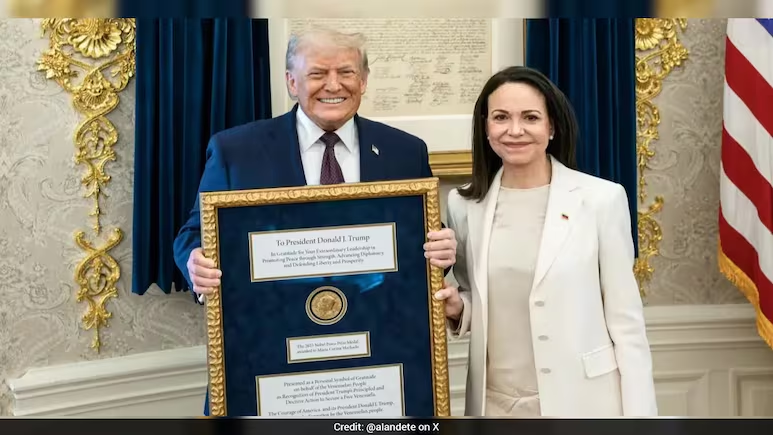
In a historic and highly symbolic gesture on January 15, 2026, Venezuelan opposition leader and 2025 Nobel Peace Prize winner María Corina Machado presented her Nobel Peace Prize medal to former U.S. President Donald Trump during a high-profile meeting at the White House in Washington, D.C. — a development that has captured worldwide attention and raised intense debate about diplomacy, legitimacy and geopolitical strategy.
A Gesture of Gratitude, Not a Transfer of Title
Machado’s act was framed not as a formal transfer of the Nobel Peace Prize, but as an emblematic expression of gratitude for what she described as Trump’s “unique commitment” to the cause of Venezuelan freedom and democratic transition. After their hour-long closed-door conversation, Machado handed Trump a framed Nobel medal inscribed with a note recognizing what she saw as his “extraordinary leadership in promoting peace through strength, advancing diplomacy and defending liberty and prosperity.”
President Trump, who had publicly expressed disappointment at not winning the 2025 Peace Prize — an award long coveted by him — accepted the medal graciously, calling Machado’s act a “wonderful gesture of mutual respect” on social media.
Yet despite pictures of the medal now in Trump’s possession, the Norwegian Nobel Institute was quick to clarify that Nobel Peace Prizes cannot be revoked, shared or transferred. The Nobel title remains exclusively Machado’s and Trump is not recognized in the official registry of Nobel laureates.
The Context: Venezuela’s Turbulent Political Landscape
Machado, a longtime advocate for democracy in Venezuela, was awarded the 2025 Nobel Peace Prize for her tireless campaigning against authoritarian rule and her efforts to uphold human rights in her crisis-plagued homeland.
Her decision to grant the medal to Trump comes amid profound uncertainty in Venezuela’s political future. Earlier this month, U.S. forces captured former President Nicolás Maduro and his wife in a dramatic operation, deepening political turmoil and provoking sharply divergent reactions at home and abroad.
Despite her Nobel laureate status, Machado has encountered reluctance from the Trump administration regarding her leadership potential. Trump has publicly questioned her political credibility and expressed skepticism about her ability to unify Venezuela domestically — even as he praised her symbolic gesture.
Mixed Reactions at Home and Abroad
The White House exchange drew immediate reactions from international observers, political analysts and Nobel experts alike. Supporters of Machado argue the gesture cements U.S.–Venezuelan alliances in the push for democratic reforms, while critics say it underscores Washington’s disproportionate influence and raises questions about true sovereignty. Nobel officials, meanwhile, reiterated that although the physical medal may change hands, the prestigious title is tied forever to the official laureate and cannot be reassigned.
On the Venezuelan streets and online, opinions are sharply divided. Some view Machado’s outreach to the United States as bold diplomacy; others see it as politically risky or symbolic to the point of irrelevance. International commentators also weighed in, with Norwegian figures expressing surprise at the unprecedented act of gifting a Nobel medal in a political context.
What Happens Next?
As Venezuelan leadership and geopolitical strategy continue to evolve, Machado’s future role remains unsettled. While she maintains substantial international recognition thanks to her Nobel accolade, critics argue the medal episode could complicate her political capital. Trump’s acceptance — though symbolic — bolsters his global image among supporters, especially considering his longstanding public pursuit of a Nobel Prize.
The meeting also signals a complex era in U.S.–Latin America relations, where diplomacy, military strategy and symbolic gestures intertwine. Whether the medal will influence diplomatic negotiations or Venezuela’s path to stability remains an open question, but one thing is certain: this moment has redefined how Nobel honors can resonate far beyond their Scandinavian roots.